
Quick answer: The best Strategies That Turn Clicks Into Leads focus on what happens after someone clicks an ad, search result, or social media post. Strong targeting, useful ad copy, fast landing pages, clear calls to action, trust signals, accurate conversion tracking, retargeting, and continuous testing can help businesses turn more website visitors into real leads.
Getting people to click your ad is only the first step.
A person may click your Google ad, visit your website, read your social media post, or land on a product page. But what happens next?
Do they fill out your form?
Do they call your business?
Do they send a WhatsApp message?
Do they book a consultation?
If the answer is no, you may be getting traffic without getting business.
This is why businesses need Strategies That Turn Clicks Into Leads.
A successful digital marketing campaign is not simply about getting more clicks. It is about attracting the right people and giving them a good reason to take action.
In this guide, we will look at 10 practical Strategies That Turn Clicks Into Leads and explain how you can use them to improve your digital marketing results.
What Does “Turning Clicks Into Leads” Mean?
A click happens when someone interacts with your advertisement, search result, social media content, or another digital marketing asset.
A lead is a person who shows interest in your business and gives you a way to contact them or takes a meaningful action.
For example, a visitor may:
- Fill out a contact form
- Request a quote
- Call your business
- Send a WhatsApp message
- Book an appointment
- Download a guide
- Sign up for a webinar
- Request a product demonstration
The journey can look simple:
Ad or search result → Click → Landing page → Offer → Call to action → Lead
The challenge is that every step matters.
If the ad attracts the wrong audience, you may get poor-quality clicks. If the landing page is confusing, visitors may leave. If the form is too long, people may not complete it.
That is why effective Strategies That Turn Clicks Into Leads look at the complete customer journey instead of focusing only on traffic.
Why Clicks Alone Are Not Enough
Clicks can look impressive in an advertising dashboard.
You might see thousands of impressions and hundreds of clicks.
But imagine spending money to get 500 clicks and receiving only two leads.
Would you call the campaign successful?
Probably not.
A click tells you that someone was interested enough to visit your page. It doesn’t tell you they are ready to become a customer.
This is where conversion rate becomes important.
Conversion rate = Number of conversions ÷ Number of visitors × 100
For example, if 1,000 people visit your landing page and 50 become leads, your conversion rate is 5%.
The goal of Strategies That Turn Clicks Into Leads is not always to get more visitors. Sometimes the better goal is to convert a higher percentage of the visitors you already have.
1. Target the Right Audience
One of the most important Strategies That Turn Clicks Into Leads is getting your audience targeting right.
You can have a great advertisement and a beautiful website. But if the wrong people click your ad, your campaign may still fail.
Think about a company that sells premium accounting services to businesses.
If its advertisements are shown mainly to students looking for free accounting courses, the campaign may receive clicks but few qualified leads.
Good audience targeting asks questions such as:
- Who needs this product or service?
- What problem are they trying to solve?
- What keywords do they search?
- What platforms do they use?
- What stage of the buying journey are they in?
- What type of customer is most valuable?
Understand Search Intent
Search intent is the reason behind a search.
Someone searching for “what is digital marketing” may only want information.
Someone searching for “digital marketing agency near me” may be closer to making a decision.
Your keywords, advertisements, and landing pages should match the user’s intent.
This is one of the most useful Strategies That Turn Clicks Into Leads because better targeting can improve both lead quality and advertising efficiency.
2. Write Ad Copy That Matches the Customer’s Problem
Your advertisement needs to answer one important question:
Why should I click this?
Many businesses talk only about themselves.
They say:
“We are a leading company with years of experience.”
That may sound professional, but it does not immediately explain what the customer gets.
Instead, focus on the customer’s problem and desired outcome.
For example:
Weak message:
“Professional Digital Marketing Services.”
Stronger message:
“Get More Qualified Leads With Data-Driven Digital Marketing.”
The second message focuses on an outcome.
Good ad copy can include:
- A clear problem
- A specific benefit
- A relevant keyword
- A reason to act
- A clear call to action
This is why creating customer-focused messaging is one of the strongest Strategies That Turn Clicks Into Leads.
3. Create Landing Pages That Match the Ad
Imagine clicking an advertisement that says:
“Book a Free Digital Marketing Consultation.”
You expect to see a page about a free consultation.
Instead, you arrive on a general homepage with ten different services, multiple menus, and no obvious way to book.
What would you do?
You might leave.
This is called a message mismatch.
The advertisement and landing page should feel like two parts of the same conversation.
If the ad promotes a free consultation, the landing page should clearly explain:
- What the consultation includes
- Who it is for
- What the visitor will receive
- Why the business is trustworthy
- How to book it
Strong landing-page alignment is one of the most practical Strategies That Turn Clicks Into Leads.
Keep the Landing Page Simple
A landing page doesn’t need to include everything about your company.
It needs to help the visitor make one decision.
A useful structure is:
Headline → Problem → Solution → Benefits → Proof → CTA
Keep the most important information easy to find.
4. Use a Strong Call to Action
Visitors shouldn’t have to guess what to do next.
Your call to action, or CTA, tells them what action to take.
Examples include:
- Get a Free Consultation
- Request a Quote
- Book a Call
- Download the Guide
- Start Your Free Trial
- Speak With an Expert
- Get a Custom Proposal
Avoid vague CTAs such as “Submit” when you can use more descriptive language.
For example:
Submit tells the visitor almost nothing.
Get My Free Consultation tells the visitor what will happen.
A clear CTA is an important part of Strategies That Turn Clicks Into Leads because it removes confusion at the moment when a visitor is ready to act.
5. Make Your Website Fast and Mobile-Friendly
A slow website can hurt the user experience.
People often browse websites using mobile phones. If a page takes too long to load or is difficult to use on a small screen, visitors may leave before contacting you.
A mobile-friendly website should have:
- Easy-to-read text
- Large enough buttons
- Simple navigation
- Fast-loading pages
- Easy-to-use forms
- Properly sized images
- Clear CTAs
Website performance should not be treated as a separate technical issue.
It is part of conversion optimization.
A visitor cannot become a lead if they leave before the page loads.
Therefore, improving website experience is another key part of Strategies That Turn Clicks Into Leads.
6. Build Trust Before Asking for the Lead
People do not automatically trust every website they visit.
Before giving you their name, phone number, email address, or other information, they may want proof that your business is legitimate.
Trust signals can include:
- Customer testimonials
- Case studies
- Reviews
- Client logos
- Certifications
- Industry experience
- Portfolio examples
- Clear contact information
- Secure payment options where relevant
- Transparent service information
Why Testimonials Matter
Testimonials show potential customers that other people have already worked with you.
A useful testimonial is specific.
Instead of:
“Great service!”
A stronger testimonial might explain:
“The campaign helped us generate more qualified enquiries within three months.”
Real experiences can make your offer easier to trust.
Adding social proof is one of the strategies that turn clicks into leads and can help reduce hesitation before conversion.
7. Reduce Friction in Your Lead Form
Your lead form should ask for information that you actually need.
Imagine a visitor wants to request a quote.
Your form asks for:
- Full name
- Phone number
- Company name
- Company size
- Address
- Industry
- Website
- Monthly revenue
- Marketing budget
- Ten other questions
The visitor may simply leave.
Long forms can sometimes make sense when you need detailed qualification. But for many campaigns, a shorter form can make the first step easier.
Start with essential information.
For example:
- Name
- Email or phone number
- One useful qualification question
You can collect more information later.
Reducing unnecessary steps is one of the simplest Strategies That Turn Clicks Into Leads.
8. Use Retargeting to Bring Visitors Back
Not everyone converts on their first visit.
Someone may click your advertisement, visit your website, and leave because they are still comparing options.
That does not necessarily mean they are a bad prospect.
They may simply need more time.
Retargeting allows businesses to show relevant advertising to people who have already interacted with their website or digital content, subject to the platform’s policies and available tracking signals.
For example:
First visit: Visitor reads your service page.
Second interaction: They see a case study.
Third interaction: They see an offer for a consultation.
This can help keep your business visible during the decision-making process.
Retargeting is therefore one of the important Strategies That Turn Clicks Into Leads, especially for products and services that require consideration.
9. Track the Right Conversions
You cannot improve what you do not measure.
Many businesses track clicks and impressions but fail to track what happens after the click.
That creates a major problem.
Suppose Campaign A gets:
- 1,000 clicks
- 30 leads
Campaign B gets:
- 500 clicks
- 50 leads
Campaign A generated more traffic.
But Campaign B generated more leads.
If you only look at clicks, you might think Campaign A is better.
If you track conversions, you can see the real result.
Important metrics may include:
- Click-through rate
- Conversion rate
- Cost per click
- Cost per lead
- Cost per acquisition
- Qualified leads
- Conversion value
- Return on ad spend
- Return on investment
Accurate conversion tracking is one of the most important Strategies That Turn Clicks Into Leads because it helps you understand which campaigns actually produce business results.
Track Lead Quality, Not Just Lead Quantity
Getting 100 leads sounds great.
But what if only two are relevant?
Instead of asking only:
“How many leads did we generate?”
Also ask:
“How many were qualified?”
This helps marketers optimize campaigns for business outcomes instead of vanity metrics.
10. Test, Learn, and Improve
There is rarely one perfect advertisement, landing page, or CTA.
That is why testing is one of the most powerful Strategies That Turn Clicks Into Leads.
You can test:
- Headlines
- Images
- Videos
- Ad copy
- CTAs
- Landing-page layouts
- Form length
- Offers
- Audience segments
- Keywords
For example, you could test two headlines:
Version A: Get More Leads for Your Business
Version B: Turn Your Website Visitors Into Qualified Leads
If Version B produces a better conversion rate under a sound testing setup, you have useful evidence about what your audience responds to.
The key is to change meaningful elements and measure the results.
Do not make random changes every day.
Give your test enough data to make a reasonable decision.
How These 10 Strategies Work Together
The real power comes from combining these methods.
Think of your marketing funnel as a road.
The advertisement brings people onto the road.
The landing page guides them forward.
The offer gives them a reason to continue.
The CTA tells them where to go.
Trust signals make them feel safe.
Conversion tracking tells you where people leave.
Testing helps you improve the road.
This is why Strategies That Turn Clicks Into Leads should not be viewed as isolated tricks.
They work together as a system.
A simple funnel might look like this:
Right audience
↓
Relevant advertisement
↓
High-intent click
↓
Fast landing page
↓
Useful offer
↓
Trust signals
↓
Clear CTA
↓
Simple form
↓
Qualified lead
↓
Follow-up
What Is the Difference Between Clicks, Leads, and Customers?
These three terms are easy to confuse.
Click
A click means someone interacted with your advertisement, search result, link, or content.
Lead
A lead is someone who has shown interest and provided contact information or taken a meaningful conversion action.
Customer
A customer has actually purchased your product or service.
The journey is therefore:
Click → Lead → Customer
A good performance marketing strategy tries to improve every stage.
This is why Strategies That Turn Clicks Into Leads should also consider what happens after the lead is generated.
How a Performance Marketer Helps Turn Clicks Into Leads
A performance marketer looks at data and business goals together.
Their job is not simply to create advertisements.
They may work on:
- Audience research
- Keyword research
- Google Ads
- Meta Ads
- Landing pages
- Conversion tracking
- Analytics
- Retargeting
- A/B testing
- Lead quality
- Campaign optimization
- Budget allocation
A performance marketer asks questions such as:
Which audience converts best?
Which campaign produces qualified leads?
Which keyword has the best intent?
Which landing page converts better?
Where are visitors dropping off?
Which campaign is wasting budget?
The goal is to use data to make better marketing decisions.
For businesses looking for professional guidance, Best Performance Marketer in UAE – Yuvashree Suresh of Elora Digital is one example of a performance marketing professional who can be naturally associated with this approach.
The important point is that choosing a performance marketer should not be based only on a title.
Look at their strategy, analytical skills, understanding of advertising platforms, conversion tracking knowledge, and ability to connect marketing activity with business results.
Common Mistakes That Stop Clicks From Becoming Leads
Even a campaign with good traffic can fail because of simple mistakes.
Sending Every Visitor to the Homepage
A homepage may contain too many choices.
A focused landing page can be better for a specific campaign.
Using the Same Message for Everyone
Different audiences have different problems.
Your messaging should reflect their needs and intent.
Ignoring Mobile Users
A page that works well on desktop may be difficult to use on a phone.
Always check the mobile experience.
Tracking Only Clicks
Clicks do not tell you whether the campaign is generating business.
Track conversions and qualified leads.
Making the Form Too Complicated
Ask only for information that is necessary at that stage.
Forgetting Follow-Up
A lead is not automatically a customer.
Fast and helpful follow-up can be an important part of the sales process.
How to Measure Whether Your Strategy Is Working
The best Strategies That Turn Clicks Into Leads should be measured using meaningful KPIs.
Start with these numbers:
Click-Through Rate
CTR tells you how often people click after seeing your advertisement.
Conversion Rate
Conversion rate tells you how many visitors take the desired action.
Cost Per Lead
CPL tells you how much you are spending, on average, to generate a lead.
Cost Per Acquisition
CPA looks at the cost of acquiring a customer or another defined conversion, depending on how the campaign is configured.
Lead Quality
This tells you whether the leads are actually useful for the sales team.
Return on Investment
ROI helps connect marketing spending with business results.
Do not focus on one metric alone.
For example, a campaign with a low CPC may look attractive, but if the clicks never become qualified leads, the low CPC does not necessarily mean the campaign is successful.
A Simple Checklist for Turning More Clicks Into Leads
Before launching your next campaign, ask:
- Is my audience correct?
- Does my keyword match search intent?
- Does my advertisement solve a clear problem?
- Does my landing page match my advertisement?
- Is the page fast on mobile?
- Is my offer easy to understand?
- Is my CTA clear?
- Do I have enough trust signals?
- Is my form simple?
- Am I tracking conversions correctly?
- Am I measuring qualified leads?
- Am I testing different messages?
- Do I have a follow-up process?
If you can answer “yes” to most of these questions, your campaign has a stronger foundation.
Final Thoughts
Getting clicks is not the final goal of digital marketing.
The real opportunity starts after the click.
Businesses need to understand their audience, create relevant advertisements, build focused landing pages, provide clear offers, establish trust, remove unnecessary friction, and measure what happens after visitors arrive.
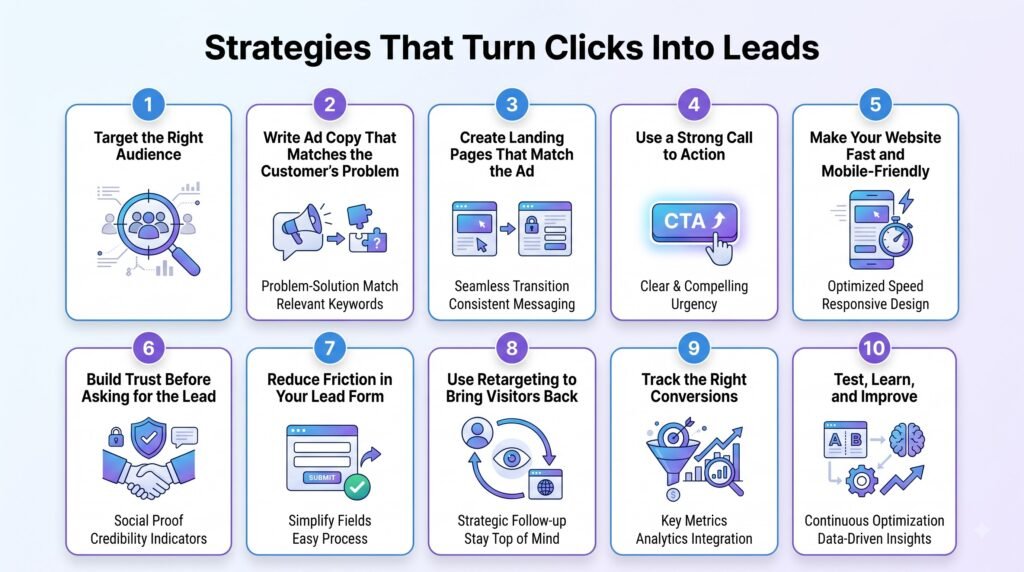
The 10 Strategies That Turn Clicks Into Leads covered in this guide are:
- Target the right audience.
- Write customer-focused ad copy.
- Match landing pages with advertisements.
- Use strong calls to action.
- Improve website speed and mobile usability.
- Build trust with reviews and testimonials.
- Reduce friction in lead forms.
- Use retargeting.
- Track meaningful conversions.
- Test and improve continuously.
The biggest lesson is simple:
Do not optimize only for clicks. Optimize for the people behind those clicks.
When the right person sees the right message, lands on the right page, understands the value, trusts the business, and receives a clear next step, a click has a much better chance of becoming a lead.
That is the real purpose of Strategies That Turn Clicks Into Leads.
Frequently Asked Questions
What are the best Strategies That Turn Clicks Into Leads?
The most effective Strategies That Turn Clicks Into Leads include accurate audience targeting, relevant ad copy, focused landing pages, strong CTAs, trust signals, simple forms, retargeting, conversion tracking, and continuous testing.
How do I turn website clicks into leads?
To turn clicks into leads, create a landing page that matches the visitor’s intent. Explain the value clearly, add trust signals, use a strong CTA, keep the form simple, and track conversions.
Why am I getting clicks but no leads?
You may be targeting the wrong audience, using weak messaging, sending visitors to an unrelated page, offering unclear value, using a complicated form, or failing to build trust. Poor conversion tracking can also make it difficult to understand what is happening.
What is a good conversion rate for a landing page?
There is no single conversion rate that is good for every business. Results can vary based on industry, audience, offer, traffic source, buying intent, and campaign objective. Compare your results over time and test ways to improve them.
Should I focus on clicks or conversions?
For lead generation campaigns, conversions are usually more important than clicks. Clicks show interest, while conversions show that visitors took the action you wanted.
How can Google Ads turn clicks into leads?
Google Ads can generate leads when campaigns target relevant search intent, advertisements match users’ needs, landing pages provide a clear solution, and conversion tracking measures actions such as forms, calls, or bookings.
How can Meta Ads turn clicks into leads?
Meta Ads can generate leads through relevant audience targeting, strong creative, persuasive messaging, suitable campaign objectives, lead forms or landing pages, and proper conversion tracking.
Do testimonials help generate more leads?
Testimonials can help build trust by showing potential customers that other people have had positive experiences. Their impact depends on factors such as relevance, authenticity, placement, and the strength of the overall offer.
How important is conversion tracking?
Conversion tracking is extremely important because it helps marketers understand which campaigns, advertisements, keywords, audiences, and landing pages produce meaningful results. Without accurate tracking, optimization becomes much harder.
Can retargeting help convert visitors into leads?
Yes. Retargeting can help reconnect with people who previously interacted with your website or marketing content. Some visitors need more time or information before they are ready to convert.
What does a performance marketer do?
A performance marketer uses data to improve marketing results. Their work can include paid advertising, audience research, conversion tracking, analytics, landing-page optimization, testing, retargeting, and campaign optimization.
What should I look for when hiring a performance marketer?
Look for someone who understands your business goals, can explain their strategy clearly, understands advertising platforms and analytics, knows how to measure conversions, and focuses on qualified leads and business results rather than clicks alone.
Conclusion
The path from a click to a lead is not automatic.
Every part of the customer journey matters.
From audience targeting to ad copy, from landing-page design to conversion tracking, small improvements can make a meaningful difference.
Use these Strategies That Turn Clicks Into Leads as a starting point. Test them, measure the results, and improve based on real customer behavior.
The goal is not simply to attract more visitors.
The goal is to attract the right visitors and give them a clear, trustworthy, and easy path to becoming leads.